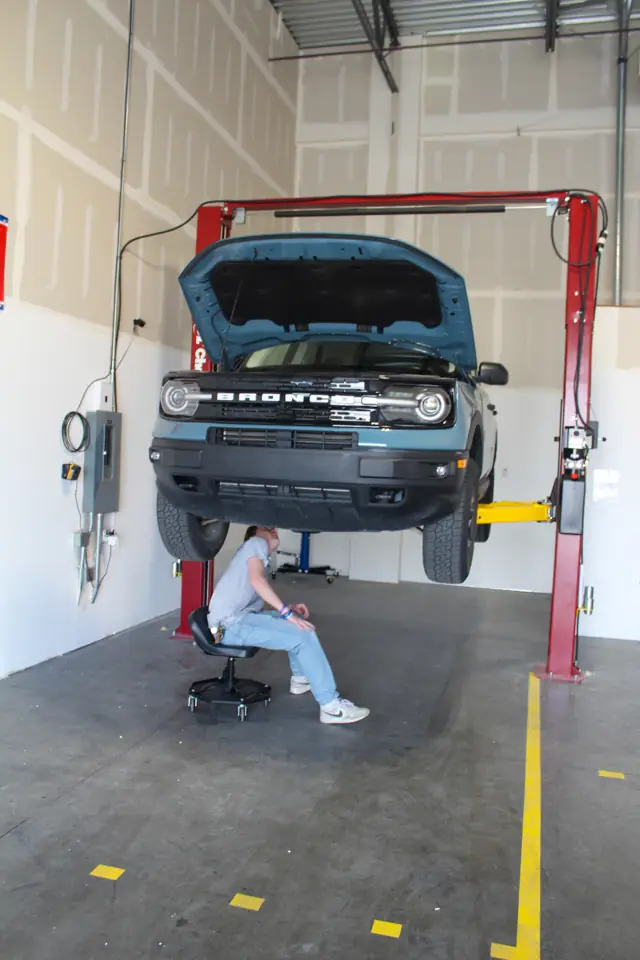
Your car weighs somewhere around 3,500 to 4,500 pounds depending on what you drive. A two-post lift picks that up on four steel arms and holds it there, sometimes with you standing directly underneath. That's the whole reason the safety video isn't optional here, and it's worth understanding the rules behind it before you're the one standing under a raised truck wondering if you did something wrong.
None of this is complicated. Most of it is just paying attention at the exact moments people usually stop paying attention.
Watch the video before you touch anything
Every first-time visitor has to watch the required lift safety training video before their first booking. It's about three minutes. Nobody's skipping it, and there's no staff walking you through the controls in person afterward either, so it's genuinely the only training you get. Watch it at home the night before if you can. Trying to absorb lift operation for the first time while you're already standing in the bay, parts in hand, is a bad way to learn it.
Load points aren't a suggestion
Every lift arm has a rated contact point built into the vehicle, usually near the pinch welds or the factory jack points. Those exist because that's where the car's structure can actually take the weight. The frame, the rocker panels, and pretty much anywhere else on the underside were not built to hold the full weight of the car on four small pads. Guess wrong here and the car can shift or slip off the arm while it's in the air. Check your owner's manual for the exact points if you're not sure, and don't eyeball it.
Lock the arms, latch the safety, every time
Once the car's up where you want it, confirm the arms are locked and the safety latches are engaged before you get under it. It takes about five seconds and it's the single easiest step to skip when you're in a hurry. Don't skip it. A lift that's holding a car on hydraulic pressure alone, without the mechanical latch backing it up, isn't something you want to trust your body under.
Stay within the rated capacity, and don't work alone under it
Never load the lift past its rated capacity. And never leave a raised vehicle unattended with anyone still underneath it, even for a two-minute parts run. If you need to step away, lower the car or bring someone with you who knows to wait. Honestly, this is less about the lift failing and more about the ordinary stuff going wrong at the worst possible time.
Keep the floor clear while the lift's moving
Hoses, breaker bars, drain pans, whatever's on the ground becomes a trip hazard the second the lift starts moving, whether that's you moving or the car moving. Get in the habit of clearing the floor before you hit the button, not after you've already tripped over something.
Something feel off? Stop.
An odd noise, a drift, a warning light on the lift itself. Any of that means stop and text us at 385-300-0774 before continuing, don't try to work around it. This is one of the few things where the honest answer is: we'd rather you interrupt your repair and ask than push through something that felt wrong.
Not confident yet? Skip the lift for this job
Not every repair needs a lift. If you're doing something simple and you're not sold on getting underneath a raised car your first time out, a floor space rental runs $25 an hour, about half the lift bay rate, and still comes with every one of the 1,000+ tools in the building. There's no rule that your first visit has to involve the lift at all.
Check the FAQ page if you're wondering what supervision looks like beyond the video (there isn't any, you're on your own for the repair itself) or whether you can extend your time if the job runs long. Book through the reservation widget whenever you're ready, pick Provo or West Valley City, and know the load points before you ever hit the lift button.